
BYD puts a folding steering wheel into a production SUV. Here's what it is, and whether it could come here
Why it matters: Fang Cheng Bao's Bao 5 and Bao 8 are already sold in Australia as the Denza B5 and B8, so the brand's cars do reach us. But BYD hasn't said anything about exporting the Tai 9, and there's no word on a right-hand-drive version, so treat it as a look at where car interiors are heading, not a car you can order.
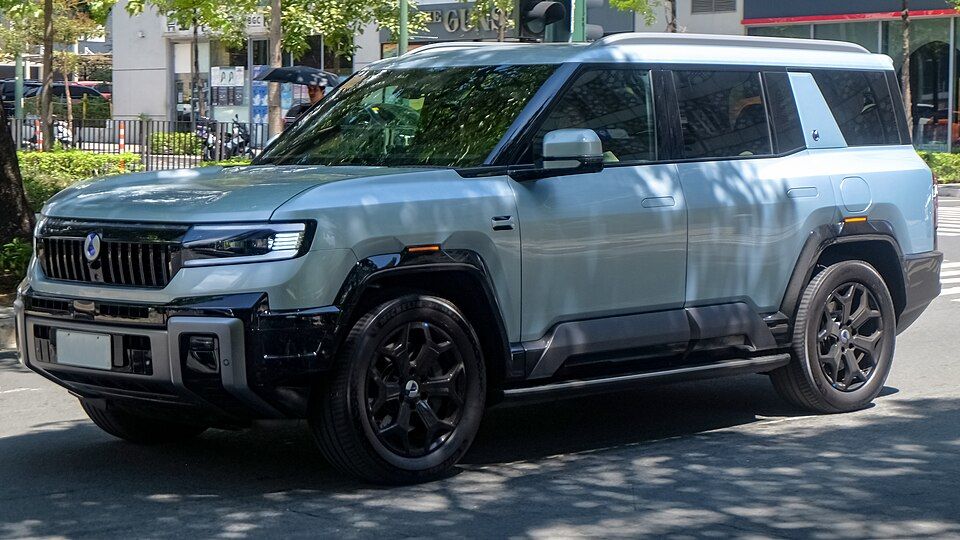
BYD's off-road brand, Fang Cheng Bao, launched its largest SUV, the Tai 9, in China on Thursday 19 November. On the top version, the steering wheel folds out of the way: when the car is parked, it swings through 180 degrees and stows into the dashboard in about 10 seconds. According to Electrek, the brand's general manager said the industry had talked about folding wheels since 2016 without getting one into mass production.
How it works
The trick is steer-by-wire. In a normal car a steering column physically links the wheel to the front wheels. In the Tai 9 there's no mechanical link: sensors read the wheel and electric motors turn the front wheels, so the wheel itself can move out of the way. Electrek reports that China's new national standard for steering systems, which took effect on 1 July 2026, dropped the requirement for a mechanical link, as long as the system has backups and fail-safes. It also reports that BYD rates the mechanism for 80,000 folds.
The rest of the car
The Tai 9 is a six-seat plug-in hybrid (two seats in each of three rows), 5,270 mm long, with a 1.5-litre turbo petrol engine and electric motors front and rear making a combined 400 kW. Fang Cheng Bao claims 0–100 km/h in 4.8 seconds. The 66.48 kWh Blade battery gives a claimed 310 km of electric driving on the WLTC test cycle (400 km on China's more generous CLTC test), and the claimed combined range with a full tank and full battery is 1,630 km. Rear-wheel steering, lidar and BYD's God's Eye B driver-assist system are standard.
Prices in China are 279,900, 299,900 and 329,900 yuan for the three versions, and only the most expensive gets the folding wheel. CnEVPost converts the starting price to about US$41,700. These are Chinese prices and say little about what the car would cost here.
Will it come to Australia?
There's no plan announced. Fang Cheng Bao's cars do reach Australia, under the Denza badge: the Denza B5 and B8 are the Bao 5 and Bao 8 sold in China. Electrek reports that the smaller Tai 7 is sold in the UK as the BYD Ti7, but says BYD hasn't said anything about exporting the Tai 9. A steer-by-wire car would also need to meet Australian design rules, and there's no word on a right-hand-drive version.
Our view
We think the folding wheel is the headline, but steer-by-wire is the real story. A wheel that tucks away only when you're parked is mostly a lounge feature for now: handy for watching a movie while you charge, not a change to how you drive. Taking the steering column out frees up cabin space and is a step towards cars that can drive themselves. The fair question is reliability: steering with no physical link has to be proven over years and many kilometres, and we'd want to see that record before getting excited about it reaching Australian roads.
- Entry version279,900
- Middle version299,900
- Top version (folding wheel)329,900
Data: CnEVPost and Electrek (19 Nov 2026). Chinese prices in yuan, not Australian prices. The Tai 9 has not been announced for Australia.
More EV news
- BYD says regional buyers on below-median incomes are the biggest users of novated leases on its best-seller 25 November 2026
- Tesla starts rolling out FSD v15 with 'Reality View' and a 25x claim. What it actually says, and what it means here 24 November 2026
- Hyundai's next Porter work truck has been spied testing as an EV. What we know, and what's only rumour 23 November 2026
- Polestar 4 gets a free over-the-air update with Android 15, camping mode and vehicle-to-load 22 November 2026
- Watch: Chery's new tech lets a car drive sideways and spin on the spot 6 November 2026
- Tesla's Cybercab, the car with no steering wheel, is on show in Melbourne 5 November 2026
The EV Pick Monthly
The month's new cars, prices, battery breakthroughs and power deals for Australians, in one short email. Five-minute read, once a month.
One email a month. Unsubscribe any time. Privacy · Past issues
More guides
You might also like
How we work it out, and our sources
Weekly cost = the car's energy use × 250 km × your electricity or fuel price, with 90% of charging at home. Prices are list prices at November 2026; check with the dealer.
- Electricity: 2026–27 default rates (AER, Victorian Default Offer, state retailers). Public charging: Sydney network prices, July 2026.
- Petrol and diesel: capital-city daily averages from state government price feeds, via FuelRadar, 12 November 2026. Diesel for Hobart, Canberra and Darwin is estimated from the national fall.
- Cars: maker figures via CarExpert, Drive, CarsGuide and EV Central. Plug-in electric range is taken as 80% of the claim.
- Servicing: published capped prices; marked as an estimate where not yet published (CarExpert comparison).
- Tyres: an EV set lasts about 35,000 km, a petrol or hybrid set 50,000 km (RACV); prices from Gridly.
- Home charger: about $2,000 installed ($1,000–$3,000). Novated leases: PwC summary.
Printed from EV Pick Australia · evpick.com.au. Prices and costs are estimates; check with the dealer. © 2026 EV Pick (T. Crouch). For personal use only; not to be copied, republished or sold without permission.
Was this page useful?
Glad this helped ☕
If EV Pick saved you time or money, a coffee helps keep it independent. Every dollar goes back into improving the site.