
Legends: the first Toyota Prius
The first Prius went on sale in Japan in December 1997 and reached Australia in 2001 for $39,990. It looked odd and sold slowly, but it proved hybrids could go the distance: one Cairns Prius taxi passed 550,000 km. It's why nearly every Toyota now comes as a hybrid.
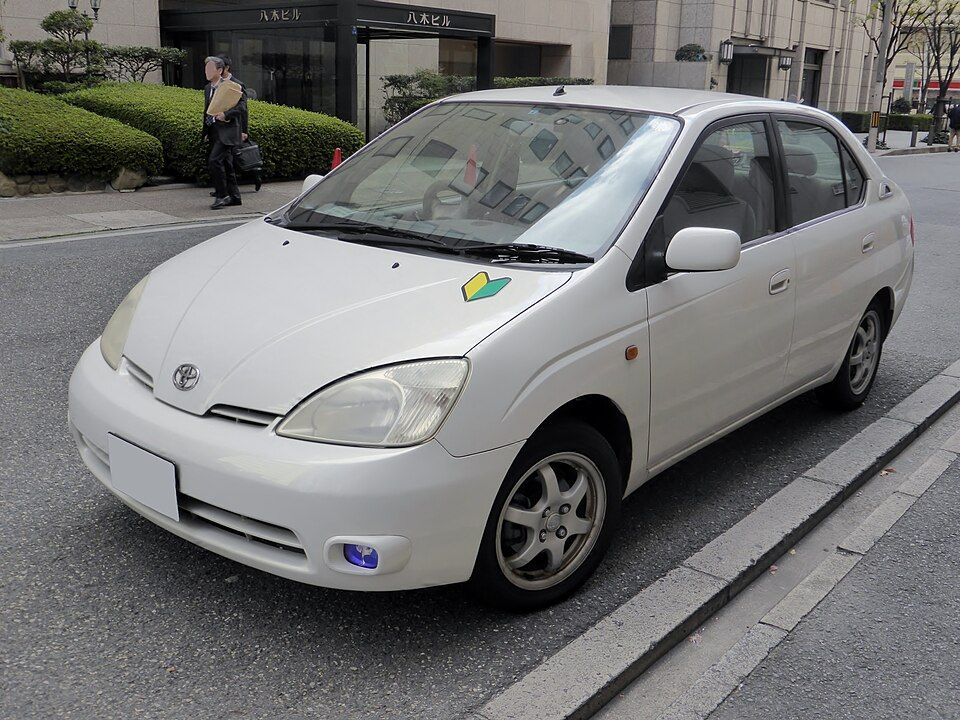
The car nobody knew they needed
Toyota started the project, code-named G21, in 1993. The first prototype reportedly stopped after just 500 metres. Four years later the Prius went on sale in Japan on 10 December 1997, the world's first mass-produced petrol-electric hybrid.
A slightly bigger, more powerful export version arrived in Australia in 2001, launched at the Sydney Motor Show. It cost $39,990 before on-road costs (about $64,000 in today's money), and sat nav was a $3,800 option. Just 137 found homes in that first year.
How it works
A small 1.5-litre petrol engine works with an electric motor through a clever planetary gearset instead of a normal gearbox. A 1.78 kWh nickel-metal hydride battery, about 53 kg, is charged by the engine and by braking. It never plugs in.
Toyota claimed 4.2 L/100 km on the highway and 4.6 L/100 km around town in Australia. That was remarkable for a family sedan in 2001.
Not sure how the hybrid types differ? Hybrid types explained.
Why it never dies
The hybrid system has fewer parts that wear: no conventional gearbox or clutch, no starter motor, and brakes that last a long time because the motor does much of the slowing. Taxi drivers noticed.
A Cairns Prius taxi had passed 550,000 km by 2008, with its battery replaced at around 500,000 km. At the time, only two Australian Prius taxis were known to have needed a new battery at all.
What it led to
The second-generation Prius (2003–2009) became the one everyone recognises, peaking at 3,413 Australian sales in 2008. By 2022 the Prius family had sold more than 5 million worldwide, and Toyota had sold over 10 million hybrids by 2017.
Toyota dropped the Prius from Australia in 2022, but the idea won: the RAV4, Corolla and Camry hybrids all use descendants of its hybrid system. Compare today's hybrids: every hybrid and plug-in.
Buying one today
First-generation cars are now rare and more than 20 years old, so treat one as a curiosity, not cheap transport. The hybrid battery is the big question: ask whether it's been replaced or reconditioned, and walk away if the hybrid warning light is on. The second-generation car (2003–2009) is far more common and easier to find parts for.
Use our used EV checklist for the battery and paperwork checks; most apply to hybrids too.
Watch
Sources
The EV Pick Monthly
The month's new cars, prices, battery breakthroughs and power deals for Australians, in one short email. Five-minute read, once a month.
One email a month. Unsubscribe any time. Privacy · Past issues
Common questions
When did the Prius come to Australia?
The first Prius was launched at the Sydney Motor Show in October 2001 and cost $39,990 before on-road costs.
How long do Prius hybrid batteries last?
Often a very long time. A Cairns Prius taxi ran about 500,000 km before its battery was replaced. Age matters too, so a 20-year-old battery may need reconditioning or replacing.
Is the Toyota Prius still sold in Australia?
No. Toyota dropped the Prius from Australia in 2022, but its hybrid system lives on in the RAV4, Corolla, Camry and others.
More guides
You might also like
How we work it out, and our sources
Weekly cost = the car's energy use × 250 km × your electricity or fuel price, with 90% of charging at home. Prices are list prices at October 2026; check with the dealer.
- Electricity: 2026–27 default rates (AER, Victorian Default Offer, state retailers). Public charging: Sydney network prices, July 2026.
- Petrol and diesel: ACCC capital-city averages, 21 October 2026.
- Cars: maker figures via CarExpert, Drive, CarsGuide and EV Central. Plug-in electric range is taken as 80% of the claim.
- Servicing: published capped prices; marked as an estimate where not yet published (CarExpert comparison).
- Tyres: an EV set lasts about 35,000 km, a petrol or hybrid set 50,000 km (RACV); prices from Gridly.
- Home charger: about $2,000 installed ($1,000–$3,000). Novated leases: PwC summary.
Printed from EV Pick · evpick.com.au. Prices and costs are estimates; check with the dealer. © 2026 EV Pick (T. Crouch). For personal use only; not to be copied, republished or sold without permission.